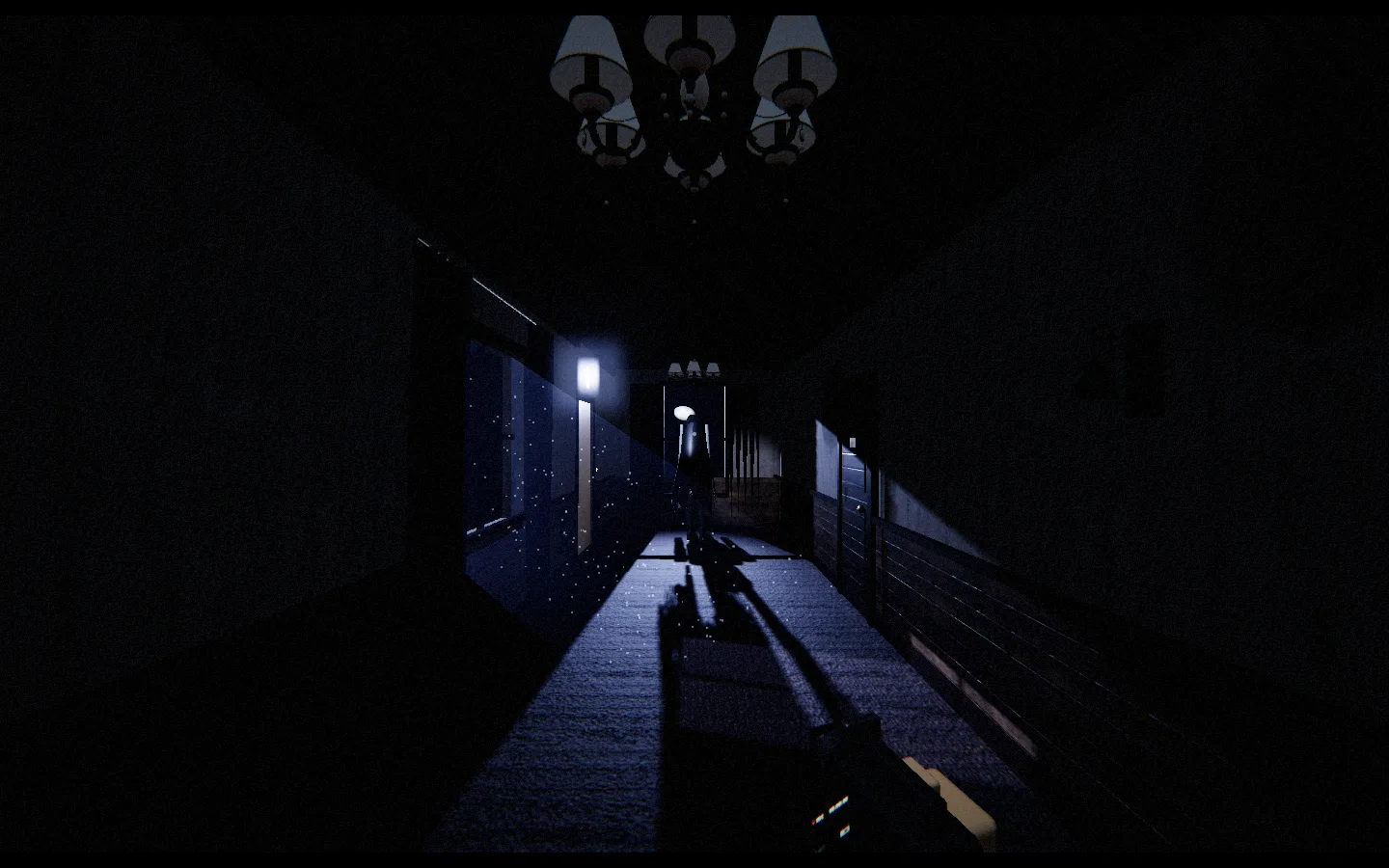
Most horror games stay politely inside the screen. With Check-In we wanted the fear to follow you out of it.
The setup is simple. You and your friend Raj run a ghost-debunking channel, and tonight you are filming at the Hollowmere Hotel, where guests who stay out after 11 PM have a habit of disappearing. At reception you give the front desk your mobile number. Up on the fourth floor, the clock strikes eleven, the power dies, Raj is gone — and your real phone rings.
That one moment shaped most of the engineering. A game that phones people is only scary if it is also careful, so the rules around the call became part of the design rather than an afterthought.
The call, beat by beat
On desktop, the call is placed the moment you step into the moonlit corridor:
- A few seconds later you hear static and a ringtone in the game, and your phone rings on the desk. The subtitle says "…must be Raj."
- When you answer, the game freezes your controls. On the line: breathing, a whisper.
- Then, quietly: "Look behind you."
- The call ends and you get your camera back — but only the camera. You have to turn round yourself.
What you see when you do is the reason the game exists. The call is just the door you walk through to get there.
Consent is a mechanic
Calling someone's real number is a privilege, so the front desk asks properly:
- Explicit opt-in. You choose to leave a number. Without one, the game simply plays the same call through an in-game phone.
- An 18+ gate before the number is accepted.
- Quiet hours. No calls between 10 PM and 8 AM, whatever happens in the game.
- Hard limits. At most three calls in a run and four to any number in a day.
- Opt-out at any point.
There is also a call ten minutes after the game ends — whether you escaped, quit or were caught. It follows the same rules, and it is the part people tell their friends about.
Fallbacks matter more than the happy path
Real phone calls fail in a dozen ordinary ways, and a horror game cannot afford to sit there waiting. So the scare never depends on the call:
- No answer in about fifteen seconds? The in-game phone plays the same audio and the story moves on.
- On a phone? The game is the phone, so the real call is saved for after the game.
- Playing with friends? Each player who left a number gets their own call; anyone who did not hears it in game.
The call provider is reached from one small server module, and the game logic only ever asks the server to place a call. If the provider is down, nothing in the game breaks.
The microphone never leaves your device
Check-In can also listen. At reception the clerk asks for your name and you say it out loud; that sets a threshold between the room's background noise and your speaking voice. During the chase, if you go over it — a gasp, a swear — The Guest whispers "There you are" and appears behind you.
Only the loudness is measured, on your own device. Nothing is recorded or uploaded, and the game plays normally if you never allow the microphone.
Testing something that phones people
You cannot test a feature like this by calling yourself a hundred times. The call server is tested with a fake clock and a fake phone provider, so the test suite can check every rule — the scare call, the post-game call, quitting by closing the tab, opt-out, quiet hours, the per-run and daily caps and rate limiting — in milliseconds, without a single real call.
What we took away
The most memorable moment in the game is also the most constrained one. Consent, quiet hours and limits did not water the scare down; they are why players trust it enough to leave their number in the first place.
If you want a game, campaign or interactive experience that reaches beyond the screen, see our game development work or tell us about it.