A minimum viable product is the smallest version of your idea that real people can use, and ideally pay for, so you can learn whether it works before spending more. In India, building one typically costs between ₹3 lakh and ₹15 lakh, and takes six to sixteen weeks.
That range is wide because "an app" can mean a booking form or a marketplace with payments, chat and three kinds of users. This guide explains what puts you at each end, and how to keep the first version small enough to ship.
Typical costs in 2026
| Type of MVP | Example | Typical cost in India | Time |
|---|---|---|---|
| Clickable prototype | Figma screens to test with users and investors | ₹50k–1.5L | 2–3 weeks |
| Simple web app | One type of user, sign-up, a core workflow, an admin view | ₹3L–6L | 6–8 weeks |
| SaaS with roles and payments | Customers, staff and admins, subscriptions, dashboards | ₹6L–12L | 8–14 weeks |
| Mobile app plus backend | iOS and Android from one codebase, plus an admin panel | ₹6L–15L | 10–16 weeks |
| Marketplace or hardware-connected product | Two-sided platforms, Bluetooth devices, real-time data | ₹12L and up | 12 weeks and up |
Freelancers can be cheaper, and large agencies can be several times more expensive. Teams in India typically cost a fraction of equivalent teams in the US or UK for the same scope, which is why many founders abroad build here.
What drives the cost
Number of user types
Every distinct kind of user, such as customer, business owner, staff member or admin, needs its own screens, permissions and testing. A product with one type of user is far cheaper than one with four. This is the single biggest lever in most MVPs.
Payments, messaging and integrations
UPI and card payments, OTP sign-in by SMS, WhatsApp or email notifications, maps, and third-party APIs each add work. They also add edge cases: failed payments, expired codes, retries. Budget for them properly.
Web, mobile, or both
A web app that works well on phones is usually the cheapest way to start, and it can be installable like an app. Native mobile apps are worth it when you need the camera, Bluetooth, background location or push notifications, or when your users simply expect an app. Building both at once roughly adds 40–60% to the cost, even with a shared codebase.
Security and data rules
If your product handles money, health data, or other people's records, the rules about who can see and change what must live on the server and in the database, not just in the interface. Done from day one it is modest extra work. Retrofitted later, it is expensive. We wrote about how we did this for a garage service-records product in making service records tamper-proof.
Design polish
A clean, consistent interface built on a good component library is affordable. Custom illustration, animation and a fully bespoke design system are not. For an MVP, clarity matters far more than polish.
How to keep an MVP from doubling in cost
- Write down the one job your product must do. Everything that doesn't serve that job goes on a "later" list.
- Cut user types. Could the admin work happen in a spreadsheet or a simple internal page for the first three months?
- Use managed services. Authentication, databases, payments and email are solved problems. Paying a few thousand rupees a month for a managed service beats paying weeks of development to rebuild one.
- Fix the scope, not just the price. A fixed price with a vague scope ends in arguments. Agree on the list of screens and flows.
- Ship in weekly milestones. You should be able to click through working software every week. If you can't see progress for a month, something is wrong.
- Plan for after launch. Set aside 15–25% of the build cost for fixes and improvements in the first three months. Real users always find things.
What you should own
Insist that the code repository, cloud accounts, domain, app-store listings and database are in your company's name from the start. If your developer disappears, you should be able to hand everything to someone else the next day.
Questions to ask a development team
- Can I use something you've built? (Not screenshots: a live product.)
- How will you handle security and permissions?
- What will it cost per month to run, at 100 users and at 10,000?
- How do we change the scope mid-project, and what does that cost?
- What happens after launch, and who fixes urgent bugs?
What we charge
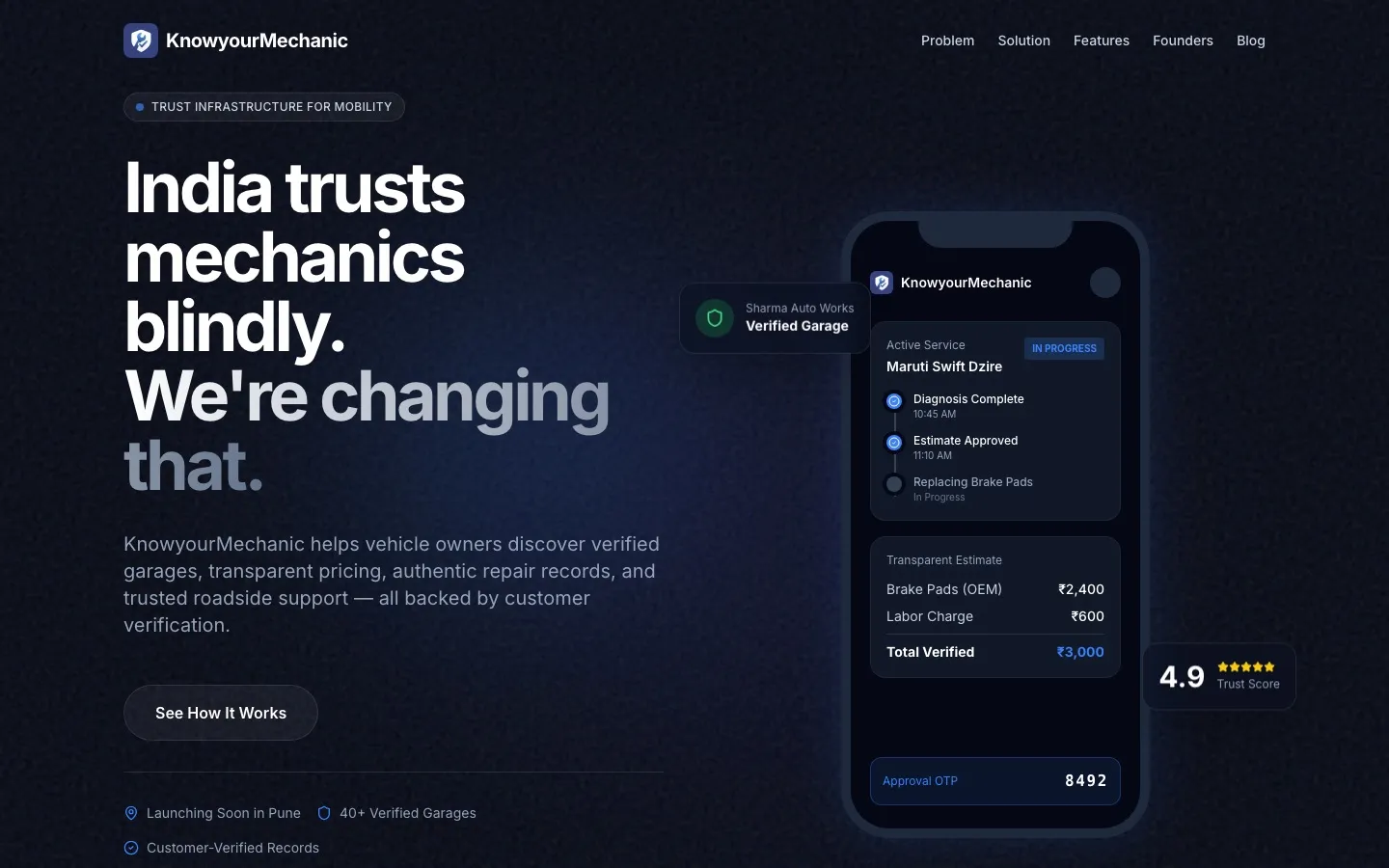
Our MVP sprints run six to ten weeks with weekly milestones and typically cost ₹3 lakh to ₹8 lakh, depending on scope. Operations software for small and medium businesses, such as inventory, service records and dashboards, starts from ₹2.5 lakh. You can see products we've built, like KnowyourMechanic and KnowyourInventory, in our work, and how we approach it on the SaaS development page.
If you have an idea and want a straight answer on what the first version would cost, tell us about it. We'll reply with a scope, a price and a timeline.